
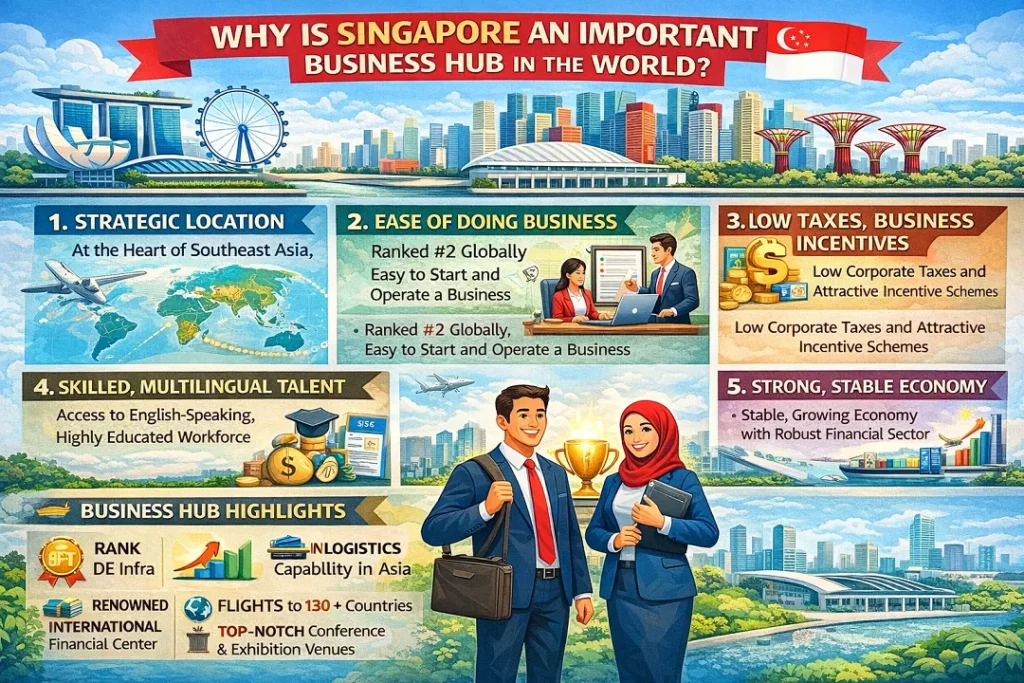
Singapore’s rise as a global economic powerhouse has attracted entrepreneurs, investors, and multinational corporations for decades. Many people ask Why is Singapore an important business hub in the world, especially when competing with established markets like New York, London, and Hong Kong. The answer lies in a unique combination of strategic geography, strong governance, advanced infrastructure, and pro-business policies that few countries can replicate.
Today, Singapore is recognised not only as a regional centre but as one of the most influential business hubs worldwide. Its ability to adapt, innovate, and maintain stability has positioned it as a preferred destination for global trade, finance, and enterprise.
Why Is Singapore a Business Hub?
To understand why Singapore is a business hub, it is essential to look at how the country balances efficiency with opportunity. Singapore offers a transparent legal system, low corporate tax rates, and minimal bureaucracy, making it easy for businesses to start, operate, and scale. These advantages reduce risk and increase confidence for international investors.
Singapore’s government plays an active role in economic planning while maintaining a free-market environment. Clear regulations, consistent policies, and strong enforcement mechanisms create a predictable business climate. This predictability is a major reason companies choose Singapore as their regional or global headquarters.
How Did Singapore Become the World’s Hub?
The question of how did Singapore become the world’s hub is closely tied to its post-independence economic strategy. With limited natural resources, Singapore focused on becoming indispensable through trade, talent, and trust. The government invested heavily in education, infrastructure, and international relations, transforming the country into a centre for global commerce.
By welcoming foreign investment and fostering industrialisation early on, Singapore built a strong manufacturing and export base. Over time, it evolved into a knowledge-based economy focused on finance, technology, logistics, and professional services. This long-term vision laid the foundation for Singapore’s global hub status.
Strategic Location and Global Connectivity
One of the strongest reasons Why is Singapore an important business hub in the world is its strategic location. Situated at the crossroads of major shipping and air routes, Singapore connects Asia with Europe, the Middle East, and the Americas. This positioning allows businesses to reach fast-growing Asian markets while maintaining global access.
Singapore’s world-class port and airport infrastructure support high volumes of trade and travel. Changi Airport and the Port of Singapore consistently rank among the best globally, enabling seamless movement of goods, people, and capital. This connectivity reinforces Singapore’s role as a central node in global business networks.
Why Is Singapore a Trading Hub?
When examining why Singapore is a trading hub, logistics and efficiency stand out. Singapore handles a significant share of global maritime trade and serves as a major transhipment centre. Its customs processes are streamlined, and its supply chain systems are among the most efficient in the world.
The country’s extensive network of free trade agreements further strengthens its trading position. Businesses operating in Singapore can access multiple international markets with reduced tariffs and regulatory barriers. This makes Singapore a preferred base for import-export companies and multinational supply chains.
Why Is Singapore a Global Financial Hub?
Another critical aspect of Singapore’s success is its status as a global financial centre. Understanding why Singapore is a global financial hub requires looking at its stable currency, strong regulatory oversight, and trusted banking system. Singapore has built a financial ecosystem that supports banking, wealth management, fintech, and capital markets.
International banks and financial institutions choose Singapore because of its political stability and strict compliance standards. These qualities attract high-net-worth individuals, institutional investors, and global corporations seeking a secure place to manage assets and investments. As a result, Singapore plays a vital role in global capital flows.
Pro-Business Policies and Tax Efficiency
Singapore’s business-friendly policies are a major reason why it is considered the best country for business by many global rankings. The corporate tax rate is competitive, and there are no capital gains taxes in most cases. Incentives for innovation, research, and international expansion further enhance profitability.
The ease of doing business in Singapore is supported by digital government services that simplify company registration, licensing, and compliance. This efficiency saves time and resources, allowing businesses to focus on growth rather than administrative hurdles.
Skilled Workforce and Talent Attraction
Singapore’s emphasis on education and skills development has created a highly capable workforce. Companies benefit from access to local talent trained in finance, technology, engineering, and management. At the same time, Singapore’s open immigration policies for skilled professionals allow businesses to recruit globally.
This blend of local and international talent contributes to innovation and competitiveness. It also explains why Singapore consistently attracts multinational companies seeking diverse, high-performing teams.
Innovation, Technology, and Future-Ready Economy
Innovation is another reason Why is Singapore an important business hub in the world, remains relevant today. The country invests heavily in technology, digital infrastructure, and research initiatives. Smart city development, fintech innovation, and sustainability projects position Singapore as a future-ready economy.
Startups and technology firms benefit from strong government support, access to funding, and partnerships with research institutions. This ecosystem encourages experimentation while maintaining regulatory oversight, balancing growth with stability.
Political Stability and Strong Governance
Political stability is a cornerstone of Singapore’s business success. Investors value consistency, and Singapore’s governance model ensures long-term policy continuity. Corruption levels are among the lowest globally, reinforcing trust in public institutions.
Strong rule of law and contract enforcement protect business interests and intellectual property. These factors are especially important for multinational companies operating across borders.
What Is the Largest Business Hub in the World?
When discussing what is the largest business hub in the world, cities like New York, London, and Tokyo are often mentioned. However, Singapore stands out not because of size alone, but because of efficiency, connectivity, and influence relative to its scale.
Singapore may be geographically small, but its impact on global trade, finance, and investment is substantial. This unique combination allows it to compete with much larger economies while offering greater operational ease.
Why Is Singapore the Best Country for Business?
Many entrepreneurs ask why Singapore is the best country for business, especially for regional or international expansion. The answer lies in its balance of opportunity and security. Businesses enjoy market access, regulatory clarity, financial stability, and strong infrastructure all in one location.
Singapore’s reputation enhances credibility, making it easier for companies to build partnerships and attract clients worldwide. This reputational advantage adds long-term value beyond immediate financial returns.
Final Thoughts
Understanding Why is Singapore an important business hub in the world requires looking beyond geography and size. Singapore’s success is the result of deliberate strategy, strong institutions, and an unwavering commitment to excellence. From trade and finance to innovation and governance, Singapore offers a complete business ecosystem that few countries can match.
As global markets continue to evolve, Singapore’s adaptability and foresight ensure that it will remain a key player in the world economy for decades to come.
Frequently Asked Questions
Why is Singapore a business hub for global companies?
Singapore is a business hub because it offers political stability, efficient regulations, global connectivity, and a trusted legal and financial system that supports international operations.
Why is Singapore a global financial hub compared to other countries?
Singapore’s strong banking sector, transparent regulations, and stable economy make it a preferred financial centre for global investors and institutions.
Why is Singapore a trading hub in Asia?
Singapore’s strategic location, advanced port infrastructure, and free trade agreements enable efficient global trade and supply chain operations.
How did Singapore become the world’s hub despite its small size?
Singapore focused on long-term planning, openness to foreign investment, and building trust through governance, allowing it to grow beyond physical limitations.
Is Singapore the best country for business today?
Singapore is widely considered one of the best countries for business due to its ease of doing business, tax efficiency, innovation ecosystem, and global reputation.