
Singapore’s ability to attract global talent is closely tied to its robust yet carefully calibrated immigration framework. Professionals relocating under the Employment Pass scheme often bring their families with them, supported by the Dependant’s Pass (DP). However, once families settle into Singapore, employment-related questions naturally emerge particularly around how to apply for work permit for Dependant’s pass in Singapore.
While Singapore remains open to foreign talent participation, it draws a clear regulatory distinction between residency rights and employment authorisation. Consequently, Dependant’s who wish to work must navigate a defined approval framework. Understanding this framework at a strategic level is not merely advisable it is essential for long-term compliance and stability.
A Dependant’s Pass holder may work in Singapore only after obtaining an approved work authorisation such as an Employment Pass, S Pass, or Letter of Consent.
The Legal Nature of the Dependant’s Pass
At its core, the Dependant’s Pass is a residency instrument. It is issued to legally married spouses and eligible children of Employment Pass or S Pass holders, allowing them to reside in Singapore for the duration of the main pass holder’s employment.
However, residency should not be conflated with labour market access. The DP does not carry implicit work rights. Therefore, questions such as can dependant pass work in Singapore or can a dependent pass work in Singapore must be answered strictly within the boundaries of employment legislation administered by the Ministry of Manpower (MOM).
This separation reflects Singapore’s broader manpower policy objective: to preserve workforce quality while ensuring that employment opportunities align with genuine economic demand.
Can Dependant’s Pass Holders Work in Singapore?
From a regulatory standpoint, DP holders may work in Singapore only if they secure prior approval through recognised work authorisation channels. Without such approval, any form of employment whether paid, unpaid, part-time, or freelance falls outside permitted activity.
As policies have evolved, Singapore has maintained consistency in enforcement while refining eligibility criteria. Therefore, while pathways exist, access is conditional rather than automatic. This is why clarity around how to apply for a work permit for Dependant’s pass in Singapore is frequently sought by both individuals and employers.
Approved Employment Pathways for DP Holders
There are currently two principal mechanisms through which DP holders may legally work. Each pathway reflects a different regulatory intent and applies under different circumstances.
Employment Pass or S Pass Application
In many cases, DP holders apply for their own Employment Pass or S Pass. This route effectively transitions the dependant into a primary work pass holder, subject to prevailing eligibility requirements.
This pathway is particularly relevant for professionals with recognised qualifications, specialised experience, and salary expectations aligned with Singapore’s market benchmarks. From a compliance perspective, this is the most straightforward and durable route, as it places the DP holder squarely within the standard foreign workforce framework.
Letter of Consent (LOC)
The Letter of Consent represents a more limited pathway. It allows eligible DP holders to work for a Singapore-registered employer without changing their pass type. However, eligibility is not universal and has become increasingly selective.
Historically, the LOC was commonly used by spouses of EP holders. Over time, MOM has tightened criteria to ensure that LOC usage aligns with genuine employment needs rather than convenience. Consequently, applicants must assess eligibility carefully before assuming this route is available.
Part-Time and Flexible Work: What the Law Actually Permits
A recurring question is can dependent pass work part-time in Singapore, particularly given the rise of flexible and hybrid employment models. From a legal perspective, the distinction between part-time and full-time work is irrelevant when it comes to authorisation.
What matters is whether the DP holder has valid approval to engage in employment activities in Singapore. Without such approval, part-time arrangements are no more permissible than full-time roles.
This principle extends to consulting, project-based engagements, and short-term assignments. Therefore, employers should avoid assuming that reduced hours equate to reduced compliance obligations.
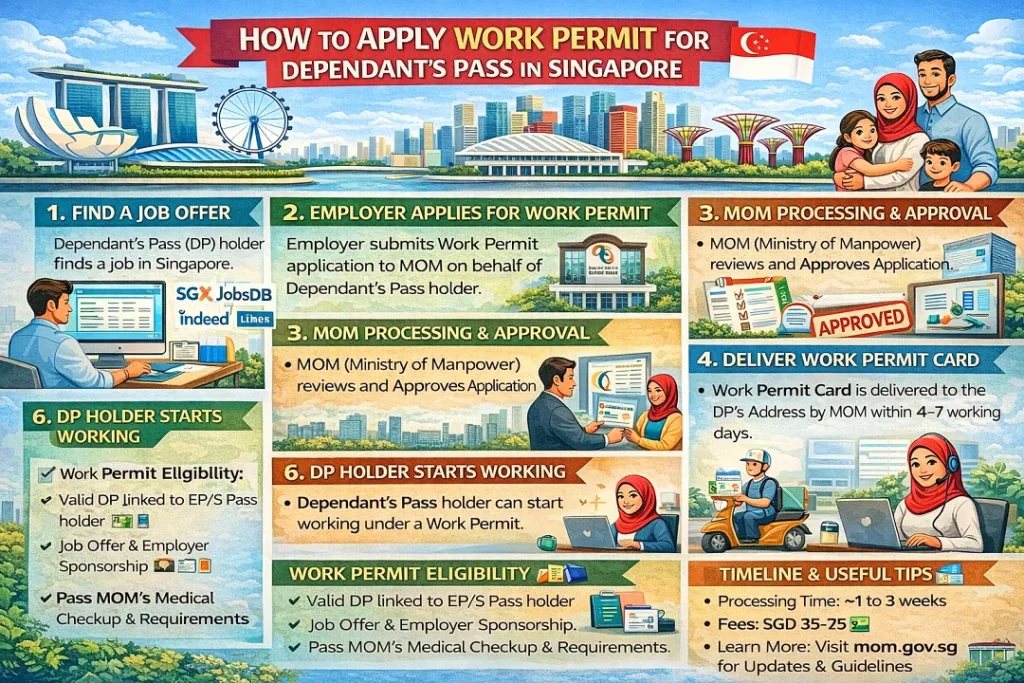
How to Apply Work Permit for Dependant’s Pass in Singapore
Although commonly phrased as a “work permit” application, DP holders do not apply for the Work Permit category reserved for semi-skilled foreign workers. Instead, applications are routed through Employment Pass, S Pass, or Letter of Consent frameworks.
From a practical standpoint, the process unfolds through a structured sequence:
- A legitimate job offer is extended by a Singapore-registered entity.
- Eligibility is assessed against MOM criteria, including salary, qualifications, and experience.
- The employer submits the appropriate application through MOM’s system.
- MOM evaluates the role, employer profile, and applicant background.
- Approval is granted before employment commences.
While the process appears procedural, outcomes depend heavily on qualitative assessment rather than form completion alone.
Key Assessment Considerations Applied by MOM
MOM’s evaluation process is holistic. Beyond qualifications, it examines whether the proposed role aligns with business needs and whether employment supports Singapore’s manpower objectives.
Role substance is a critical factor. Positions must demonstrate operational relevance rather than nominal job creation. Similarly, salary alignment with industry benchmarks signals role legitimacy and applicant seniority.
Employer credibility also influences outcomes. Companies with strong compliance records, local workforce development, and clear organisational structures typically encounter fewer challenges during review.
Employment Across Multiple Employers
Another area of frequent misunderstanding involves concurrent employment. In most cases, work authorisation is employer-specific. This means that DP holders approved to work for one company cannot automatically take on additional roles elsewhere.
Each employment relationship requires its own approval. This applies regardless of whether the roles are part-time, remote, or project-based. Consequently, DP holders considering multiple engagements must plan carefully to avoid inadvertent non-compliance.
Self-Employment and Business Activities
Self-employment presents additional complexity. DP holders are generally not permitted to operate businesses, freelance, or engage in entrepreneurial activity without appropriate authorisation.
Even where a DP holder is listed as a director or shareholder, operational involvement may still require a valid work pass. Therefore, individuals exploring business opportunities should seek professional guidance before proceeding.
Remote Work and Overseas Payroll Arrangements
With globalisation and digital work models, some DP holders assume that working for overseas companies or receiving offshore remuneration exempts them from local requirements. This assumption is incorrect.
If work is physically performed in Singapore, MOM approval is typically required regardless of where the employer is located or where salary is paid. Consequently, remote work arrangements must be assessed carefully through a compliance lens.
Compliance Risks of Working Without Approval
Singapore enforces its work pass framework rigorously. DP holders found working without authorisation may face cancellation of their passes, restrictions on future applications, or removal from Singapore.
Employers engaging unauthorized workers also face significant consequences, including fines, blacklisting, and reputational damage. As such, compliance failures often carry broader organisational implications beyond individual cases.
Strategic Planning for DP Employment
Given the regulatory complexity, DP employment decisions should be approached strategically rather than reactively. Early planning allows families to assess which pathway best aligns with career objectives, salary expectations, and long-term residency goals.
From an employer perspective, understanding DP employment rules reduces hiring risk and ensures smoother onboarding. For families, informed planning supports career continuity without jeopardising immigration status.
Conclusion
Understanding how to apply for a work permit for Dependant’s pass in Singapore requires more than procedural awareness. It demands a clear appreciation of Singapore’s manpower philosophy, regulatory priorities, and compliance expectations.
While employment opportunities for DP holders exist, they are intentionally structured and selectively granted. When approached strategically with proper authorisation, realistic role alignment, and informed planning DP holders can integrate meaningfully into Singapore’s economy without compromising immigration status.
Conversely, assumptions, shortcuts, or informal arrangements often lead to avoidable compliance exposure. In Singapore’s regulatory environment, informed decision-making remains the most reliable foundation for sustainable employment outcomes.
Frequently Asked Questions
Can Dependant’s pass work in Singapore legally?
Yes, provided the DP holder obtains an approved Employment Pass, S Pass, or Letter of Consent before commencing work.
Can DP work in Singapore without changing the pass?
In certain cases, a Letter of Consent allows employment without changing pass type. Eligibility is subject to MOM policy at the time of application.
Can a dependent pass holder work part-time in Singapore?
Part-time work is allowed only with valid work authorisation. Without approval, part-time work is not permitted.
How long does it take to apply for a work permit for dependant pass in Singapore?
Processing times vary, though most applications are reviewed within several weeks depending on complexity and documentation.
Can a dependent pass holder work for multiple employers?
Generally no. Work authorisation is employer-specific, and separate approvals are required for each engagement.